All foreign travellers visiting Tibetan areas in P.R. China require a valid passport (with minimum 6 months validity from the planned entry date into China) and a Chinese tourist visa. If you plan to visit Central Tibet (Lhasa and beyond), also known as the Tibet Autonomous Region, you will need the assistance of a tour agency to obtain a Tibet Travel Permit (TTP) for you. Here’s what you need to know before entering Tibet.
A Chinese tourist visa needs to be obtained through a visa application process. Contact the Chinese Embassy in your country to get started. A Chinese visa is all that is required for travel in Kham and Amdo Tibet, where some of the most culturally authentic experiences (and few tourists) can be found.
There are now many countries, especially in Europe, for which China has a visa-free entrance. However, the length of visit for travellers from visa-free countries varies, so be sure to check with the Chinese embassy in your country.
You’ll need a Tibet Travel Permit (TTP) to visit sites including Everest, Lhasa and other quintessential destinations in Central Tibet, also known as the Tibet Autonomous Region (TAR).
If you are visiting the TAR, the law also requires you to book a tour with a registered Tibet travel agency and to have a guide accompany you for the duration of your time there. Your tour company will process your TTP for you, as you can’t process it on your own.
You need to confirm your itinerary before your tour company can obtain your TTP, which can take up to four weeks to process.
The tour agency will request a scanned copy of your passport and a scanned copy of your Chinese visa to process your TTP.
Mailing completed permits overseas is prohibited, so your Tibet travel agency will deliver the original permit (not a copy) to your hotel in China, or meet you at the airport with it, as you will need it to enter Tibet.
The original copy of your two-page permit will be checked in your departure city for Tibet, either at the train station or airport, and upon arrival in Lhasa.
Once you arrive in Tibet, your guide will assume responsibility for your TTP and will use it to check you into your hotel, to purchase tickets to tourist attractions and at checkpoints along your route.
Contact us here at Extravagant Yak if you have any questions about getting your permit, what each region has to offer, and anything else you need answered while planning your trip to the Roof of the World.
Contact us today
“China Closes its Everest Base Camp to Tourists” - this is typical of the headlines that have been splashed across global news channels over the past couple of weeks. While it sounds like foreign travellers will be blocked from going to Everest in 2019, this is not what is happening. There are changes at Everest in 2019, but they do not affect the view of the mountain offered to travellers, and these changes are for the better of the mountain.
The reality is that the actual base camp for climbers has always been restricted to all but those who have an Everest climbing permit. This means the furthest that regular tourists were permitted to overnight previously was at the “tent hotels” - a small seasonal camp of yak wool tents set up by local Tibetans. This camp has traditionally been located about 3km beyond Rongbuk Monastery (chinese, Rongphu Si), near Dza Rongbuk Hermitage, but still several kilometers from the climber's base camp.
These tent hotels hosted travellers for hot tea, provided simple local food, and further offered accommodation to those who wished to overnight. From the tent hotel location, a park bus was provided to carry tourists a further 2km up the valley to the closest viewpoint non-climbers could access.
The furthest point that tourists can go in 2019 is Rongbuk Monastery. For many travellers, Rongbuk Monastery offers their favourite view of the mountain. A short walk up the hillside near the monastery offers the iconic view of Everest’s north face with the monastery in the foreground. Most people would say that the panoramic view from this spot is as good as anywhere else in the valley, and some would argue that this location offers the best all round view of the mountain.
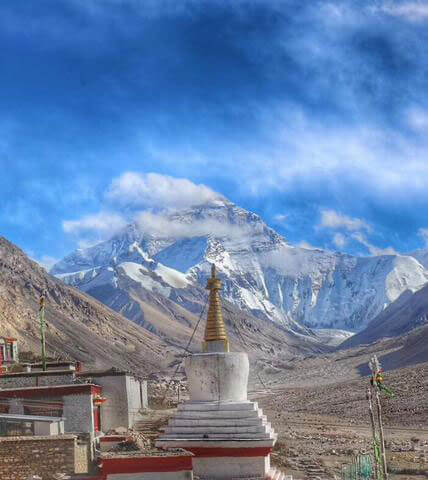
As described above, the further 5km step past Rongbuk Monastery to the “tent hotels” and the viewpoint beyond will not be permitted in 2019. However, the stunning views of Everest from the monastery are at least as good as the views further up the valley.
The good news is that the local government is implementing a massive clean up project at Everest. This overdue project began in 2018 with tonnes of waste being hauled away, and will continue in 2019. This massive clean up effort will proceed further up the mountain to even include removing the remains of climbers who have died in the Death Zone.
Everest climbing permits for the 2019 season are being restricted to 300. Eco-friendly toilets are being planned for the future, along with better garbage disposal, and even a seasonal medical clinic to serve tourists. No one would disagree that better management of the natural environment around Everest is in the best interest of everyone.
Questions?
We're here to help! Our team is on the ground in Tibet and we're happy to answer any questions you may have.